
Combining social science and ecology to conserve striped bass
This article was written by Dr. Grace Casselberry, a Postdoctoral Research Associate at the University of Massachusetts Amherst.
If you’re an angler on the east coast of the United States, chances are you’ve had your hands on a striped bass at least once. Stripers are one of the most popular recreationally targeted saltwater species. Every year during their seasonal coastal migrations, over 20 million striped bass are caught in the recreational fishery. In 2024, 19.1 million of those fish were released either because of an angler’s catch-and-release mindset or because they fell outside of the small slot limit meant to protect big, reproductive fish from harvest and small fish that have not yet had a chance to spawn.
Despite their immense popularity, we know surprisingly little about how striped bass are affected by catch-and-release angling practices. Similarly, we know very little about how anglers handle the stripers they catch. These two things go hand-in-hand and can be addressed by combining social science with ecological studies.
Understanding how anglers target and interact with striped bass, as well as how striped bass respond to various handling practices can develop best practices specific to striped bass catch-and-release as well as identify specific places where angler behavior change can have the greatest impact. Biologists at the University of Massachusetts Amherst, including myself, addressed these knowledge gaps with two recently published studies. Together, our findings highlight that anglers’ good intentions don’t always translate to best outcomes for fish.
What do striped bass anglers believe?
A coast-wide survey of over 1,600 striped bass anglers from Maine to Georgia revealed that striper anglers largely value conservation. Most respondents to the survey expressed support for regulations like slot and bag limits, including strong support for the 2023 emergency action that shrank the slot limit to allow harvest only of fish between 28 and 31 inches. Many also reported that they practiced voluntary catch-and-release regularly.
But the study also uncovered some key knowledge gaps and inconsistencies between what anglers believe and what they do when handling striped bass. While nearly all anglers acknowledged that handling practices, like air exposure and fight time, could have a significant impact on the fish, fewer were aware of the effects of water temperature and fish size. Awareness also did not always translate to action, with many anglers still reporting that they remove their striped bass from the water when landing their catch. Despite catching millions more striped bass than the commercial fishery, recreational anglers felt that commercial fishing was a larger threat to the striped bass fishery rather than their own individual capture and handling practices.
Generally, it appears many anglers want to do the right thing but don’t always do so or know how to do so when a striper is on the line or in their hands.
What do striped bass experience when caught, handled, and released?
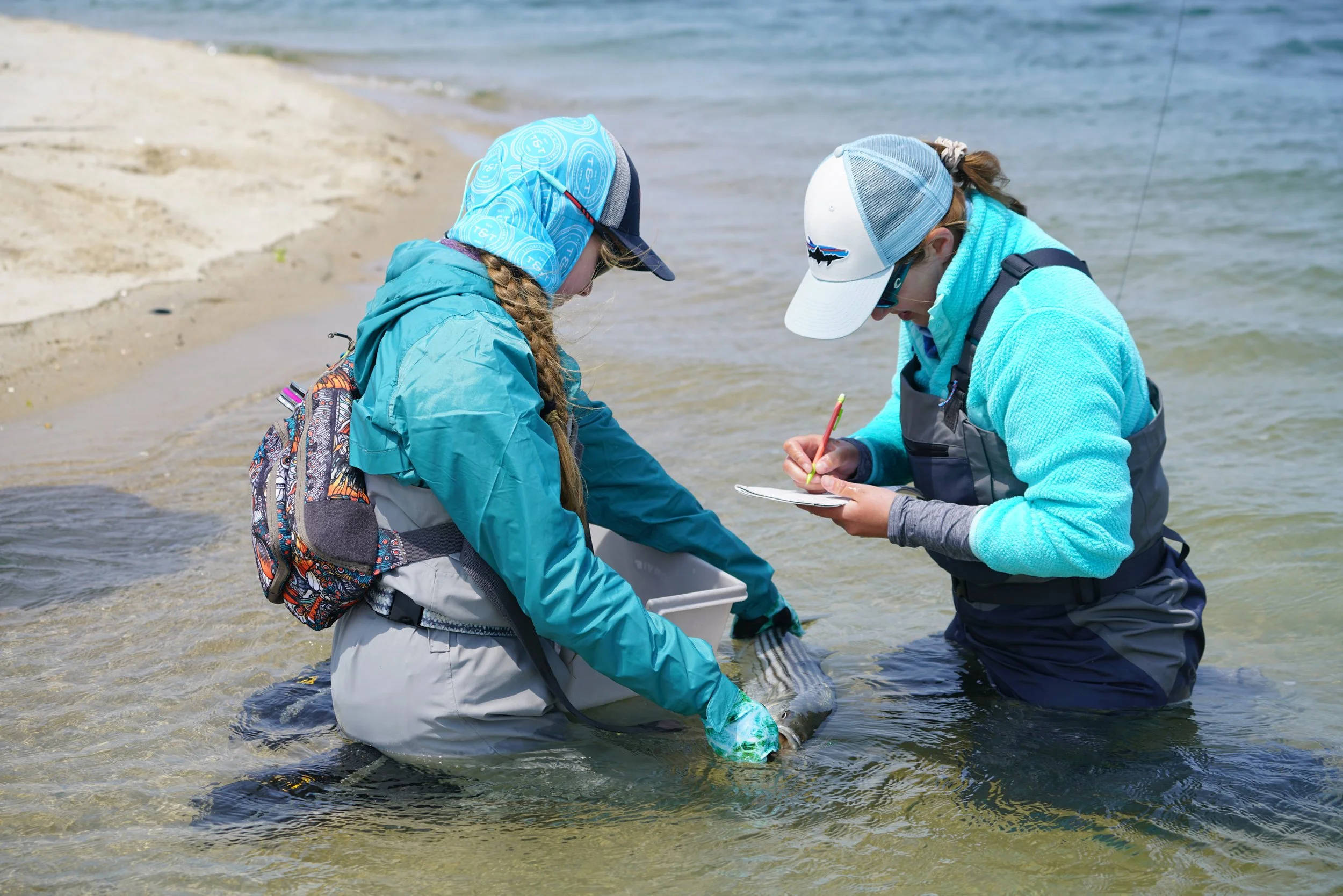
UMass Amherst researchers collaborated directly with anglers in coastal Massachusetts to better understand how angling effects striped bass after capture and handling. Their work included the first examination of how striped bass respond to air exposure. For the study, they used a combination of reflex assessment tests and accelerometers, which are essentially a FitBit for your fish, to evaluate angling stress and post-release swimming performance.
Over 500 stripers were assessed during the study, caught on conventional or fly gear with a variety of terminal tackle configurations. Fish that experienced longer fight times (> 5 minutes), longer handling times (> 2 minutes), and extended air exposure (> 30 seconds) had higher stress levels, failing more reflex tests. While immediate, boatside mortality was very low in the study (restricted to fish that were foul hooked in critical locations like the gills) the magnitude of stress that striped bass experienced increased substantially with water temperature (> 63oF) and fish size (> 25 inches).
The effect of air exposure on post-release swimming behavior was specifically examined on a subset of fish caught on spinning gear with double, barbed treble hooks, one of the most popular gear types used to target stripers. In addition to the reflex assessment, these fish received an accelerometer to monitor swimming behavior for 20 minutes after release. Some fish were not air exposed, while others were held out of the water for 30 seconds or two minutes. All fish had depressed swimming activity for the first 6 minutes after release. Beyond this point, fish that were not air exposed began to recover, exhibiting much more active swimming. Fish in the 30 second air exposure group started swimming more actively after 10 minutes, while fish in the two minute group started swimming somewhat more actively after 14 minutes. Ultimately, striped bass that were held out of the water for two minutes never swam as actively as the stripers that were not air exposed.
These findings emphasize that air exposure has a substantial effect on fish recovery time. Holding stripers out of the water for two minutes to remove hooks and/or take photos compounds the effects of the angling event and dramatically extends the time the fish needs to recover. This can make them more vulnerable to delayed mortality from capture stress or post-release predation which counteracts the goal of catch-and-release.
What does this mean for striped bass anglers?
Combined, these studies show that there is a disconnect between angler knowledge and action, particularly related to air exposure, which can have real consequences for the striped bass fishery. In areas like coastal New England where predator populations are recovering, fighting a striped bass for too long and then air exposing them could make them more vulnerable to predation once released. This is especially true for larger striped bass, since those fish are often air exposed for long periods of time for photos before being released. Large striped bass are major contributors to the future of the fishery, and this science shows that anglers need to be extra careful with these fish.
Simple, science-based practices can make a measurable difference the next time you head out striper fishing:
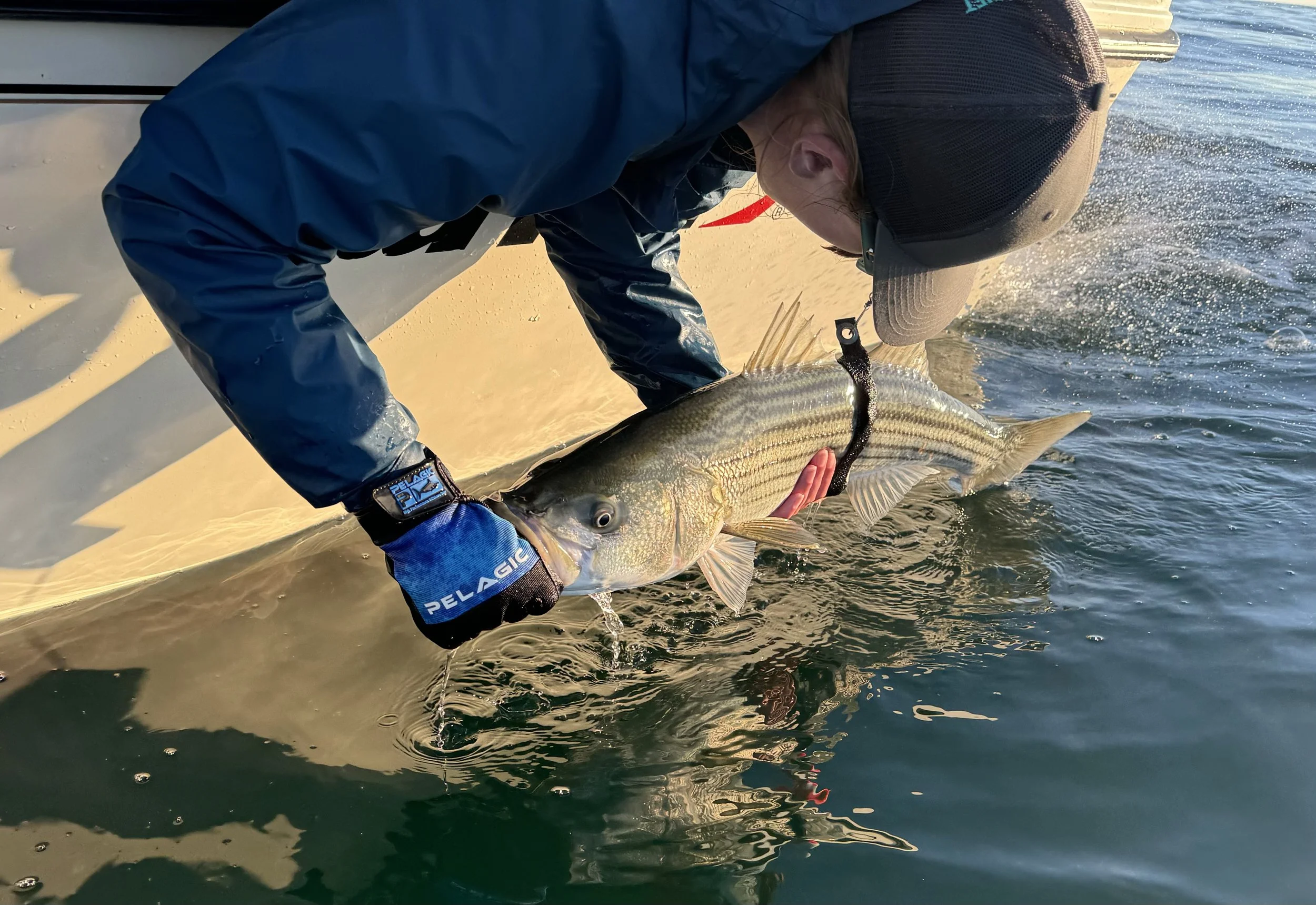
Air exposure of striped bass matters: keep striped bass in the water whenever possible; if you remove them from the water, keep air exposure to < 30 sec
Reduce fight time, especially for large striped bass that are more vulnerable to angling stress; size up your gear, your leaders/tippet, and get the fish landed.
Water temperature matters - avoid fishing in water over 63oF
Use single barbless hooks to avoid foul hooking and the time needed to remove the hooks (which increases handling time).
These small steps can make a huge difference for the future of the striped bass fishery. The fate of the striped bass fishery is in our hands. Avid, conservation-minded anglers were essential to the stock recovery efforts throughout the 1980s, and conscious angling practices can help these fish bounce back once again.
The full social science study can be found here, and the full field study can be found here.